What this reference covers
This page records how 15 US multiple listing services hand out listing data to brokers and software vendors: who each one serves, which platform delivers its data, the feed types it names, who may hold a license, the fees it publishes and where an application starts. Each statement is taken from the MLS's own site, or from the documentation of the platform that delivers its data, as read on October 12, 2026, and links to the page it came from.
The boards are listed in alphabetical order everywhere on this page. The order is not a ranking, and the page does not recommend one board, platform or vendor over another: a brokerage does not choose its MLS, its market does. “Not published” means the pages we could read do not say; it does not mean free, and it does not mean there is no rule. For the approval process itself, see how to get MLS data access.
Index: the 15 boards and how each delivers data
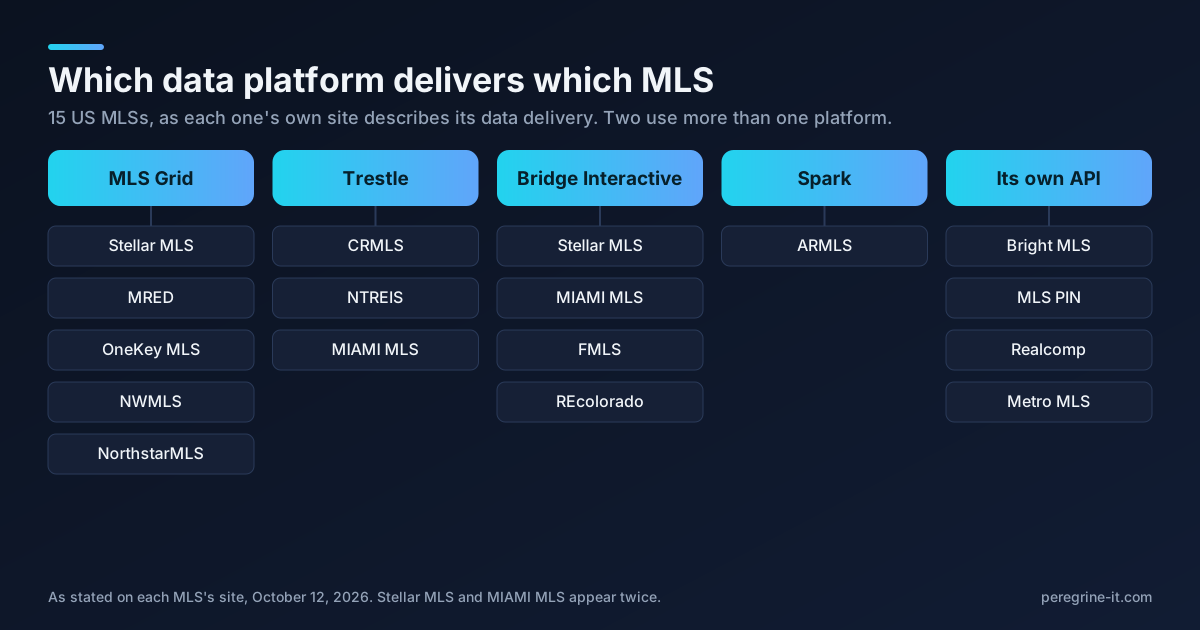
Alphabetical. Sizes are quoted as each organization states them, and they do not count the same thing: some count subscribers, some REALTOR members, some all professionals served. Each name links to its profile below.
Counted by platform: five of the 15 deliver through MLS Grid, three through Trestle, four through Bridge Interactive (two of them alongside another platform), and five issue API access themselves.
Three more names you may expect are missing. The sites of HAR (Houston) and Georgia MLS did not load for us on the day we checked, so they have no entry. Canopy MLS appears in MLS Grid's list of originating systems, which is the only fact about it we could verify.
Board profiles
Each profile has the same six lines in the same order: who the MLS serves, how its data is delivered, the feed types it names, who may license, where the application starts, and the date and pages checked. Published fees are in one table after the profiles.
ARMLS (Arizona Regional Multiple Listing Service)
- Serves: Arizona; the organization is based in Tempe. The pages we read do not state a subscriber count.
- Data delivery: The Spark API and RESO Web API. ARMLS issues API keys directly to developers and shut its RETS feeds off on December 15, 2023. It says the APIs support live queries passed straight through to a website or app.
- Feed types named: IDX, VOW, company back-office application, and brokerage listings only. Back-office data must not be displayed publicly, and ARMLS treats automated valuation models as back-office tools.
- Who may license: Participants (broker-owners or brokerage principals) are entitled to a feed of their own listings. Other broker feeds must be tied to an active ARMLS subscriber and used under broker control; the subscriber or a consultant may submit the request. Vendors apply separately, and a consultant who supports several subscribers is pointed to preferred vendor status, which allows one feed across multiple clients.
- Application starts: The broker feed intake form or the vendor intake form on its data feeds page.
- Checked: October 12, 2026. Pages read: data feeds and vendor information, RETS to API.
Bright MLS
- Serves: 100,000+ real estate professionals across the Mid-Atlantic. Bright says it was founded in 2015 through the merger of 43 real estate associations.
- Data delivery: Its own RESO Web API, which Bright calls the preferred method over the legacy RETS transport. Both are available to vendors and may be used concurrently. It states RESO Data Dictionary 1.6 Platinum certification.
- Feed types named: IDX and VOW websites; other use cases are considered by request.
- Who may license: Agents and brokerages are offered the data license; the API is available to vendors.
- Application starts: Its developers page, which points to a developer portal and a contact form.
- Checked: October 12, 2026. Pages read: about, developers (both in a browser).
CRMLS (California Regional Multiple Listing Service)
- Serves: California: more than 93,000 real estate professionals from 39 associations, boards and MLS organizations.
- Data delivery: Trestle, for a RESO API feed or a RETS feed, which CRMLS describes as a raw data connection between a website and CRMLS. It also generates frameable IDX links at no additional cost to its users.
- Feed types named: Frameable links, an IDX feed and a broker feed, which carries listing information tied to the broker's office. IDX data contains all CRMLS and data share listings.
- Who may license: Brokers or vendors, under a data licensing agreement with CRMLS. A developer working for one broker is treated as a general IDX vendor request.
- Application starts: Trestle's subscription wizard.
- Checked: October 12, 2026. Pages read: about, IDX resources.
FMLS (First Multiple Listing Service)
- Serves: Georgia and the Southeast: over 57,000 real estate professionals and REALTORS. FMLS says it was founded in 1957 by a group of brokers.
- Data delivery: Bridge Interactive, by the Bridge API, the RESO Web API or vRETS (a RETS emulator). FMLS says fields outside the RESO Data Dictionary carry an FMLS_ prefix in the Bridge feed.
- Feed types named: Not listed by type. Each use is entered as a product in FMLS Marketplace, which approves and manages all third-party data access.
- Who may license: Third-party vendors, and member brokerages for their own brokerage products.
- Application starts: An FMLS Marketplace account, then a data request in Bridge. After development the product is submitted in Marketplace; FMLS gives a typical review turnaround of 2 business days.
- Checked: October 12, 2026. Pages read: about, Marketplace information, fee exhibit.
Metro MLS
- Serves: Wisconsin: more than 9,000 members and eight Realtor associations.
- Data delivery: Its own RETS or Web API. Metro MLS advises licensees to use the Web API because RETS will be sunset soon.
- Feed types named: IDX, VOW, brokerage back-office application, automated valuation, and brokerage listings only. IDX and VOW each come as two feeds: Metro MLS, and WiREx with listings from the seven Wisconsin MLSs in that program.
- Who may license: Participants (broker-owners or brokerage principals). Subscribers who are not participants are not eligible for a direct feed, except for a VOW, and may otherwise only frame their participant's site or a named public search. Vendors apply on the participant's behalf, and fees are billed to the participant.
- Application starts: The participant feed web application; Metro MLS says other forms of application are rejected.
- Checked: October 12, 2026. Pages read: about, participant data feed information.
MIAMI MLS (MIAMI Association of REALTORS)
- Serves: South Florida. The association represents over 60,000 real estate professionals.
- Data delivery: Trestle, for head brokers and vendors, and the Bridge API, for brokers, agents and vendors. Members can also use a no-cost frameable link.
- Feed types named: The frameable link, an IDX feed, and IDX Plus, back office and VOW feeds.
- Who may license: Head brokers and vendors on Trestle; brokers, agents and vendors on Bridge. An agent with an in-house or private vendor can apply for a courtesy IDX feed by API.
- Application starts: A vendor invitation requested by email from MIAMI's IDX department for Bridge, or Trestle's application.
- Checked: October 12, 2026. Pages read: about, IDX services, IDX and API pricing (all in a browser).
MLS PIN (MLS Property Information Network)
- Serves: New England: its about page cites public records for all of Massachusetts and Rhode Island and much of New Hampshire and a subscriber base of over 37,050 real estate professionals.
- Data delivery: Its own RESO Web API server, Core 2.0.0 certified, with Data Dictionary 1.7.
- Feed types named: Free IDX links and a free manual IDX download; brokerage access; vendor or third-party access; syndicator access.
- Who may license: Brokerages, with an agreement signed by the broker of record; vendors, under a vendor data access agreement; and syndicators that run a public portal and display brokers' opted-in data for free.
- Application starts: An agreement and application obtained from MLS PIN data services, by email or phone.
- Checked: October 12, 2026. Pages read: about, data services.
MRED (Midwest Real Estate Data)
- Serves: Northern Illinois at the start, and now more than one state. The pages we read do not state a subscriber count.
- Data delivery: MLS Grid for IDX: MRED is a founding member and says it was the first MLS to launch the platform. Other data uses go through MRED directly. MRED says it is transitioning from RETS to Web API.
- Feed types named: IDX, VOW, broker back office, My Listings and My Private Listings. MRED puts participation in its IDX program at about 99.5% of all companies and listings, which is why a VOW can show listings an IDX site cannot.
- Who may license: MRED brokerages, managing brokers, brokers (agents), and vendors who have one of them as a customer.
- Application starts: MLSGrid.com for IDX; MRED's orders desk by email for all other data uses.
- Checked: October 12, 2026. Pages read: IDX and VOW data delivery, the MLS Grid, 2026 Little Book of MRED (PDF).
NorthstarMLS (Regional Multiple Listing Service of Minnesota)
- Serves: Minnesota and the Upper Midwest: more than 22,000 real estate professionals.
- Data delivery: The MLS Grid Web API; new accounts are set up through MLS Grid.
- Feed types named: IDX, VOW and back office. Its examples of third-party use are statistics tools, showing scheduling and accounting software.
- Who may license: Vendors and participants. For uses other than IDX or VOW, NorthstarMLS reviews the request and licenses only to the extent the agreement permits.
- Application starts: MLS Grid, which also bills the monthly access fee.
- Checked: October 12, 2026. Pages read: about, third-party data usage.
NTREIS (North Texas Real Estate Information Systems)
- Serves: 53,000+ real estate professionals across Texas, Louisiana and beyond.
- Data delivery: Trestle.
- Feed types named: Consumer display (IDX and VOW), back-office systems such as CMA or CRM, analytics, marketing, and licensing brokers their own data back.
- Who may license: Vendors, brokers, and agents seeking an IDX or VOW feed. For back-office access the participant completes a data access agreement before credentials are issued.
- Application starts: Trestle's subscription wizard, or NTREIS data services by email. A site submitted for approval must be open to review, applications with AI features may require additional review, and approved IDX and VOW sites are expected to be live and compliant within two weeks of approval.
- Checked: October 12, 2026. Pages read: data.
NWMLS (Northwest Multiple Listing Service)
- Serves: Washington state and Oregon: a broker-owned, not-for-profit organization with more than 2,500 member offices and 30,000+ brokers.
- Data delivery: MLS Grid, whose documentation lists Northwest MLS among its originating systems.
- Feed types named: Not published on the pages read. We found no public data licensing page on its site.
- Who may license: Not published on the pages read.
- Application starts: An MLS Grid data consumer account.
- Checked: October 12, 2026. Pages read: about, MLS Grid API documentation.
OneKey MLS
- Serves: More than 43,000 REALTORS across Long Island, Hudson Valley, Manhattan, and parts of Connecticut and New Jersey. It is owned and operated by the Long Island Board of REALTORS and the Hudson Gateway Association of REALTORS.
- Data delivery: MLS Grid, whose documentation lists OneKey MLS among its originating systems.
- Feed types named: Not published on the pages read.
- Who may license: Not published on the pages read.
- Application starts: An MLS Grid data consumer account.
- Checked: October 12, 2026. Pages read: about (in a browser), MLS Grid API documentation.
Realcomp
- Serves: Michigan: more than 16,000 REALTORS affiliated with more than 2,600 offices.
- Data delivery: Its own API: raw data goes to an IDX consultant through a data access account created by Realcomp, and data layouts are read from the API metadata. A pre-made framed search is the alternative.
- Feed types named: Framed IDX search, IDX data, VOW, and back office data for brokers.
- Who may license: Brokers and agents who are full subscribers to Realcomp. Whoever downloads and programs with the data signs the contract's IDX consultant form, and only the IDX consultant receives the account credentials.
- Application starts: The IDX contract on its IDX service page, after reading its IDX rules. Realcomp says its IDX department responds to IDX and VOW approval requests within 1 business day.
- Checked: October 12, 2026. Pages read: about, IDX for Realcomp customers, IDX service.
REcolorado
- Serves: Colorado: more than 26,000 real estate professionals.
- Data delivery: Bridge Interactive, its exclusive data delivery platform for all new data customers. MLS Grid's documentation still lists REcolorado among its originating systems.
- Feed types named: IDX, back office, VOW, and participant data access (PDAP). REcolorado grants one data feed per application, except that one back office feed may support several approved uses.
- Who may license: Vendors apply directly in Bridge. A PDAP feed needs a three-party agreement executed by the office's participant that includes the vendor.
- Application starts: A Bridge account, an application describing the product, then a data access request; REcolorado reviews it and supplies the license agreement and questionnaire that fit the use.
- Checked: October 12, 2026. Pages read: about, data, participant pricing schedule (PDF).
Stellar MLS
- Serves: 80,000+ real estate professionals, through 19 association partnerships across Florida and Puerto Rico.
- Data delivery: For IDX, two API options: MLS Grid and Bridge API.
- Feed types named: IDX, plus firm internal use (broker back office), broker data release, VOW and vendor product. Firm internal use and VOW applications must sit behind a login.
- Who may license: A three-party agreement between the broker, the vendor and Stellar MLS, one per broker. A vendor product needs at least one Stellar MLS broker as an active client and a quarterly list of shared clients. A broker data release is for brokers only.
- Application starts: The data delivery questionnaire, or MLS Grid registration for IDX. Applicants must be able to demonstrate a working product; a sample data set is offered during development.
- Checked: October 12, 2026. Pages read: about, data delivery, API options.
Published license fees, board by board
These are each MLS's own published charges, in US dollars, as read on October 12, 2026. Each MLS charges in its own unit (per feed, per office, per client, per product, per website or a flat amount), so the rows record what each one publishes and are not a like-for-like price list. Several MLSs publish only part of their schedule, and five publish none on the pages we could read.
A delivery platform may bill separately from the MLS. Trestle publishes its own per-connection fee schedule and shows the fees for a connection before you activate it; go by that figure. MLS Grid says you only pay the license fee required by your MLS, which it collects on the MLS's behalf. To total the published fees for the boards in your own plan, use the MLS and IDX cost calculator.
What recurs across the profiles
A vendor is rarely licensed alone. Stellar MLS, MRED, Realcomp and Metro MLS all tie a vendor's feed to a member broker or agent. Trestle says the same of the MLSs it serves: they typically require a real estate broker or agent to ratify the contract, or a periodic report of which members use the service.
One connector can cover several boards, or only one. MLS Grid has one standard license agreement for IDX, VOW and back office products, and its documentation lists 37 originating systems behind one API. Trestle says it carries data from over 90 multiple listing organizations. So MRED, NorthstarMLS, NWMLS, OneKey MLS and Stellar MLS share a connector, and CRMLS, MIAMI MLS and NTREIS share another. ARMLS, Bright MLS, Metro MLS, MLS PIN and Realcomp each need their own. Each board is still approved, licensed and billed one at a time: MLS Grid gives a broker data only from the MLS where it holds participatory rights.
Some platforms only replicate; others answer live queries. MLS Grid states it does not support real-time data access and provides data through replication, so you must run your own database and search. Trestle's Web API is appropriate for both real-time access and replication, and ARMLS says its APIs support live queries passed straight through to a website or app. The design that works on all of them is in the MLS data pipeline reference architecture.
RETS is at a different stage in each market. ARMLS shut its RETS feeds off on December 15, 2023. Metro MLS still offers RETS but says it will be sunset soon, MRED says it is transitioning from RETS to Web API, and Bright MLS keeps both. Build new work on the Web API; RESO Web API vs RETS covers what changes.
The platform itself can change. REcolorado's data page now names Bridge Interactive as its exclusive data delivery platform for all new data customers, while MLS Grid's documentation still lists REcolorado among its originating systems. Stellar MLS offers two platforms at once. Treat the platform as a per-feed setting in your code, and re-check it before each renewal.
One of our published projects spans four of the MLSs above. The W3|re case study describes a brokerage whose markets include Texas (NTREIS), Florida (Stellar MLS), Arizona (ARMLS) and Colorado (REcolorado), and a pipeline that ingests from the four MLS systems and normalizes their schemas. In the profiles above those four arrive over Trestle, MLS Grid or Bridge, Spark, and Bridge.
How to find which MLS covers a market
- Ask the broker first. Access follows the broker's participation, so the MLS your client belongs to is the one that matters, even where two MLSs overlap. Florida alone has two entries on this page.
- Use RESO's map and list. RESO counts 484 functioning MLS systems in the United States and more than 30 in Canada, and its certification and MLS map page links a list of certified organizations.
- Check the platform's own list. MLS Grid's API documentation names every originating system it carries. If the MLS is there, you know the platform before you speak to anyone.
- Ask what a data share adds. One feed can reach past the MLS's own members: CRMLS IDX data contains all CRMLS and data share listings, and Metro MLS offers a second feed, WiREx, with listings from the seven Wisconsin MLSs in that program. That can remove a second integration from the plan.
New-market checklist: eight questions before you estimate
Answer these from the MLS's own data page and license before putting a number on a new market. Each maps to a line in the profiles or to the fee table.
- Which MLS, and which broker? Name the participant whose membership the feed will sit under, and who signs.
- Which platform delivers the feed today? MLS Grid, Trestle, Bridge, Spark or the MLS's own API, and whether you already have a connector for it.
- Which feed type fits the use? IDX, VOW, back office or a vendor product. A public search and an internal analytics tool are different licenses at most of these MLSs.
- Who is the licensee? The broker, the agent or you as vendor, and whether a three-party agreement or a consultant form is required.
- What is the fee unit? Per feed, per office, per client, per product, per website or flat, plus any setup fee and any platform fee. Work it out at your expected client count.
- What does approval need? A working product to demonstrate, a site open for compliance review, a questionnaire, and whether AI features get extra review, as NTREIS says they may.
- Replication or live query, and is RETS involved? This sets whether the market needs your full pipeline or only a new source in it.
- What reporting and audits follow? For example, Stellar MLS asks vendors for a quarterly list of shared clients, and NTREIS expects approved sites to be live and compliant within two weeks of approval.
If you can answer all eight, the unknowns left are engineering ones. If you cannot answer the first four, the estimate is not ready, whatever the code looks like.
Canada
Canadian markets do not fit these profiles. A national feed from CREA sits beside board-level IDX and VOW programs, with different rules and fees. See MLS data access in Canada for that side of the border.
Frequently Asked Questions
Do all MLSs use the same data platform?
No. Among the 15 US MLSs profiled here, several deliver through MLS Grid, whose documentation names every originating system it carries, others through Trestle or Bridge Interactive, and several run their own API. Stellar MLS offers both MLS Grid and Bridge API.
Can a software vendor license MLS data without a broker?
Rarely. Stellar MLS requires a three-party agreement between the broker, the vendor and Stellar MLS, and Trestle says the MLSs it serves typically require a real estate broker or agent to ratify the contract. Plan on having at least one member broker as a client in each market.
Which MLSs publish their data license fees?
Of the 15 here, ten publish at least some fees on their own pages: ARMLS, CRMLS, FMLS, Metro MLS, MIAMI MLS, MLS PIN, NorthstarMLS, NTREIS, REcolorado and Stellar MLS. Bright MLS, MRED, NWMLS, OneKey MLS and Realcomp did not publish fees on the pages we could read on October 12, 2026. For example, NTREIS states its vendor pricing on its data page and MLS PIN on its data services page.
Does one MLS Grid or Trestle account cover every MLS on the platform?
One account and one API, but not one approval. On MLS Grid a broker gets data only from the MLS where it holds participatory rights, and on Trestle each connection has its own MLS license fee, which varies greatly by market.
How do I find out which MLS covers a city?
Ask the broker you are building for which MLS they participate in, then confirm on that MLS’s site. RESO counts 484 functioning MLS systems in the United States and links a list of certified organizations from its certification and MLS map page.
All figures and rules were read from the linked pages on October 12, 2026. The boards are in alphabetical order, which is not a ranking. Member counts are quoted as each organization states them and do not count the same thing. Fees, platforms and rules change, and several MLSs publish only part of their schedule: your license and the MLS's current page decide. HAR, Georgia MLS and Canopy MLS are left out because their pages could not be read that day.
Adding a market to an existing product, or starting with several at once? See our MLS and IDX integration service. Every project starts with a 30-minute technical discovery call with an engineer.
